Parkheuvel
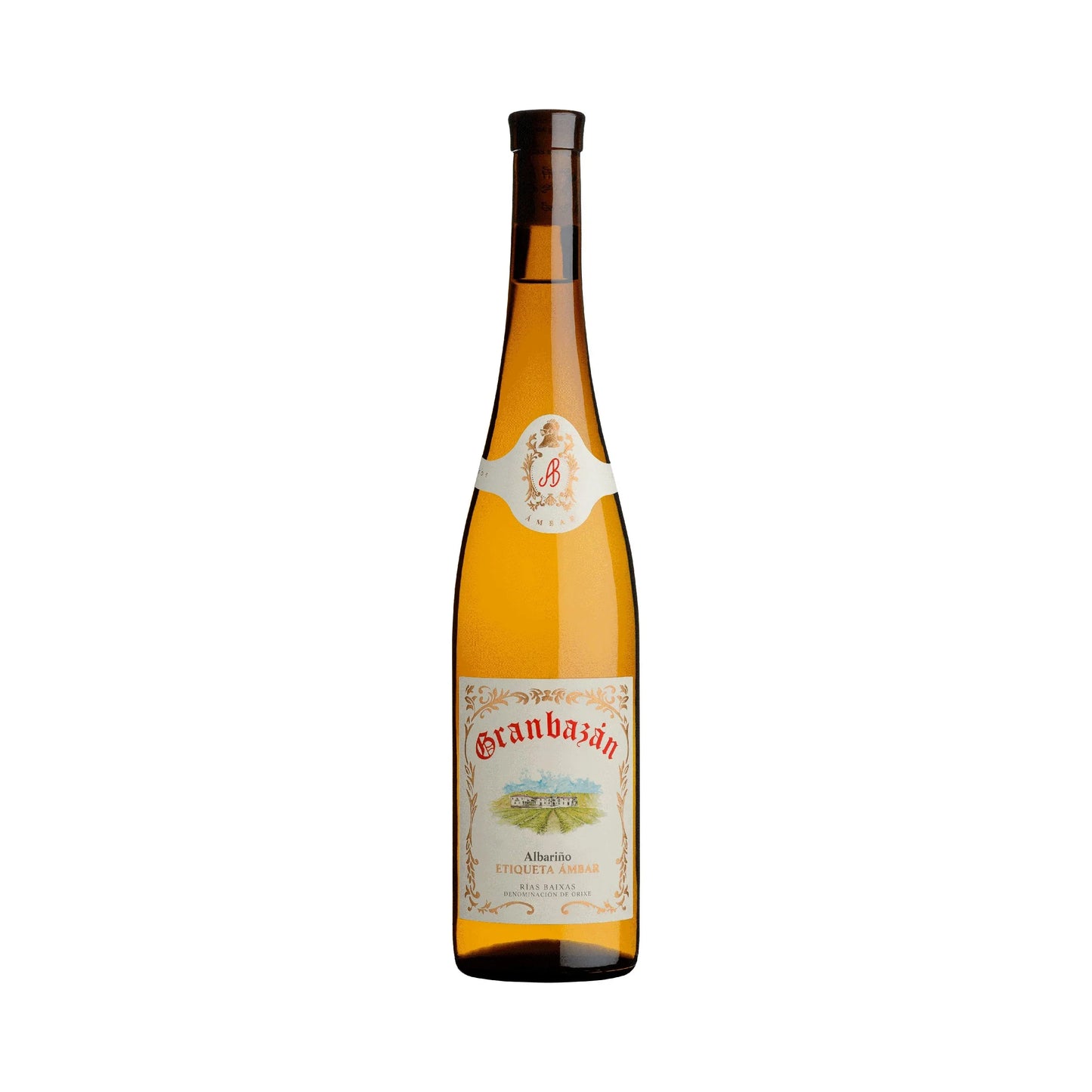
Parkheuvel - Wine with the Pumpkin - Granbazán
Classification: DO Rías Baixas
Type of Wine: Full-bodied white wine
Closure: Cork
Suitable for vegans
Country: Spain
Region: Galicia
Producer: Agro de Bazán, Vilanova de Arousa
Grape variety(ies): albariño
Winemaking: The specially selected grapes are harvested by hand. After destemming, a cold soak follows at 6 to 9°C for 8 hours. This releases more aromatic compounds into the must. For fermentation, the grapes go into stainless steel tanks; due to the grapes' own weight, part of the juice drains off. This 'free-run juice' ferments at a maximum of 20°C for 5 weeks, then the wine remains on the lees for at least 4 months. This increases the wine's complexity and makes it softer. Ambar (brown) refers to the color of the label. The 'Ambar' is a 'vino de Lagrima', a free-run wine.
Producer information: Since 1988, Agro de Bazán has been making wine from about 13 ha of its own vineyard. In addition, they control 45 ha of vineyard from 200 winegrowers. In the 1970s and 1980s, Rías Baixas was an unknown wine region, where viticulture was highly fragmented. The local population made wine from very small plots with little knowledge, mostly for private use, sometimes for local sale, often without a label on the bottle. Wine distribution was very limited. When demand increased, Manuel Otero Candeira had the idea to create volume through his own production and by purchasing grapes from winegrowers, making sales outside the region and export possible. For this, he invested large sums in buildings, cellars, and equipment. The best winemakers were also attracted. Quality improved by leaps and bounds, and the wines became highly sought after. No wonder Agro de Bazán is seen as the pioneer of the region, with wines among the very best in the area. Since 2017, the company has been taken over by Pedro Martínez, who, in addition to a bodega in Rioja, now invests heavily in Agro de Bazán to bring the albariños to an even higher quality level. Diego Ríos is the young, promising Chilean oenologist with much experience, including in the Mosel.
Area information: The Rías Baixas area is located in Galicia, the far northwest of Spain. The Rías Baixas, or 'lowland rivers', are large fjord-like inlets and bays. This D.O. of over 2,400 ha consists of 5 subregions: Condado do Tea and O Rosal on the border with Portugal along the Miño river, Soutomaior and Ribeira do Ulla further inland, and Val do Salnés, the best region for viticulture on the Atlantic Ocean coast. The soil in Val do Salnés consists of granite with an alluvial top layer. It is the coolest and wettest area of the region. Galicia has a lot of rainfall, 1520 mm per year, which is twice as much as in the Netherlands. Local wine consumption here is a multiple of that in the rest of Spain. Here, you can still often see traditional pergola viticulture, a structure of poles with slats and wires, where the grapes form something like a roof up to 180 cm above the ground. This allows the grapes to be sufficiently ventilated, so the fruit can remain healthy and not rot prematurely due to the humid climate. The thick skin of the albariño grape also reduces the risk of mildew.
Serving suggestions: With light fish dishes, shellfish and crustaceans, light white meat and poultry, pasta, vegetable dishes, salads.
Serving temperature: 8 to 10ºC
Other Information: It is often said that the albariño grape is related to riesling and was brought to Galicia by pilgrims. This is not true. Albariño is probably related to loureiro.
Allergens: sulfites
Couldn't load pickup availability
Shipping information
We deliver throughout the Netherlands (with the exception of the Wadden Islands). Our refrigerated delivery costs are €6.90 (excluding €3 service fees).
Please note: on Sunday, April 20, we will charge an increased delivery fee of €19.80 due to the national holiday. You can also choose to have your meal delivered on Saturday, April 19 for €6.90 and eat it on Sunday evening.
A small number of exclusive restaurants use a private "priority delivery service". This service costs €29.
The delivery fees we charge cover the refrigerated pickup from the restaurant and ensure that your meal is delivered to your home under optimal conditions. You will be continuously informed of the status of your order. In addition, we work with a specialized courier service that transports each meal with the greatest possible care and attention.
Tab
Tab
Classification: DO Rías Baixas
Type of Wine: Full-bodied white wine
Closure: Cork
Suitable for vegans
Country: Spain
Region: Galicia
Producer: Agro de Bazán, Vilanova de Arousa
Grape variety(ies): albariño
Winemaking: The specially selected grapes are harvested by hand. After destemming, a cold soak follows at 6 to 9°C for 8 hours. This releases more aromatic compounds into the must. For fermentation, the grapes go into stainless steel tanks; due to the grapes' own weight, part of the juice drains off. This 'free-run juice' ferments at a maximum of 20°C for 5 weeks, then the wine remains on the lees for at least 4 months. This increases the wine's complexity and makes it softer. Ambar (brown) refers to the color of the label. The 'Ambar' is a 'vino de Lagrima', a free-run wine.
Producer information: Since 1988, Agro de Bazán has been making wine from about 13 ha of its own vineyard. In addition, they control 45 ha of vineyard from 200 winegrowers. In the 1970s and 1980s, Rías Baixas was an unknown wine region, where viticulture was highly fragmented. The local population made wine from very small plots with little knowledge, mostly for private use, sometimes for local sale, often without a label on the bottle. Wine distribution was very limited. When demand increased, Manuel Otero Candeira had the idea to create volume through his own production and by purchasing grapes from winegrowers, making sales outside the region and export possible. For this, he invested large sums in buildings, cellars, and equipment. The best winemakers were also attracted. Quality improved by leaps and bounds, and the wines became highly sought after. No wonder Agro de Bazán is seen as the pioneer of the region, with wines among the very best in the area. Since 2017, the company has been taken over by Pedro Martínez, who, in addition to a bodega in Rioja, now invests heavily in Agro de Bazán to bring the albariños to an even higher quality level. Diego Ríos is the young, promising Chilean oenologist with much experience, including in the Mosel.
Area information: The Rías Baixas area is located in Galicia, the far northwest of Spain. The Rías Baixas, or 'lowland rivers', are large fjord-like inlets and bays. This D.O. of over 2,400 ha consists of 5 subregions: Condado do Tea and O Rosal on the border with Portugal along the Miño river, Soutomaior and Ribeira do Ulla further inland, and Val do Salnés, the best region for viticulture on the Atlantic Ocean coast. The soil in Val do Salnés consists of granite with an alluvial top layer. It is the coolest and wettest area of the region. Galicia has a lot of rainfall, 1520 mm per year, which is twice as much as in the Netherlands. Local wine consumption here is a multiple of that in the rest of Spain. Here, you can still often see traditional pergola viticulture, a structure of poles with slats and wires, where the grapes form something like a roof up to 180 cm above the ground. This allows the grapes to be sufficiently ventilated, so the fruit can remain healthy and not rot prematurely due to the humid climate. The thick skin of the albariño grape also reduces the risk of mildew.
Serving suggestions: With light fish dishes, shellfish and crustaceans, light white meat and poultry, pasta, vegetable dishes, salads.
Serving temperature: 8 to 10ºC
Other Information: It is often said that the albariño grape is related to riesling and was brought to Galicia by pilgrims. This is not true. Albariño is probably related to loureiro.
Allergens: sulfites
Shelf life
Shelf life
We advise consuming the dishes within 2 days of receipt.
Parkheuvel - Wine with the Pumpkin - Granbazán