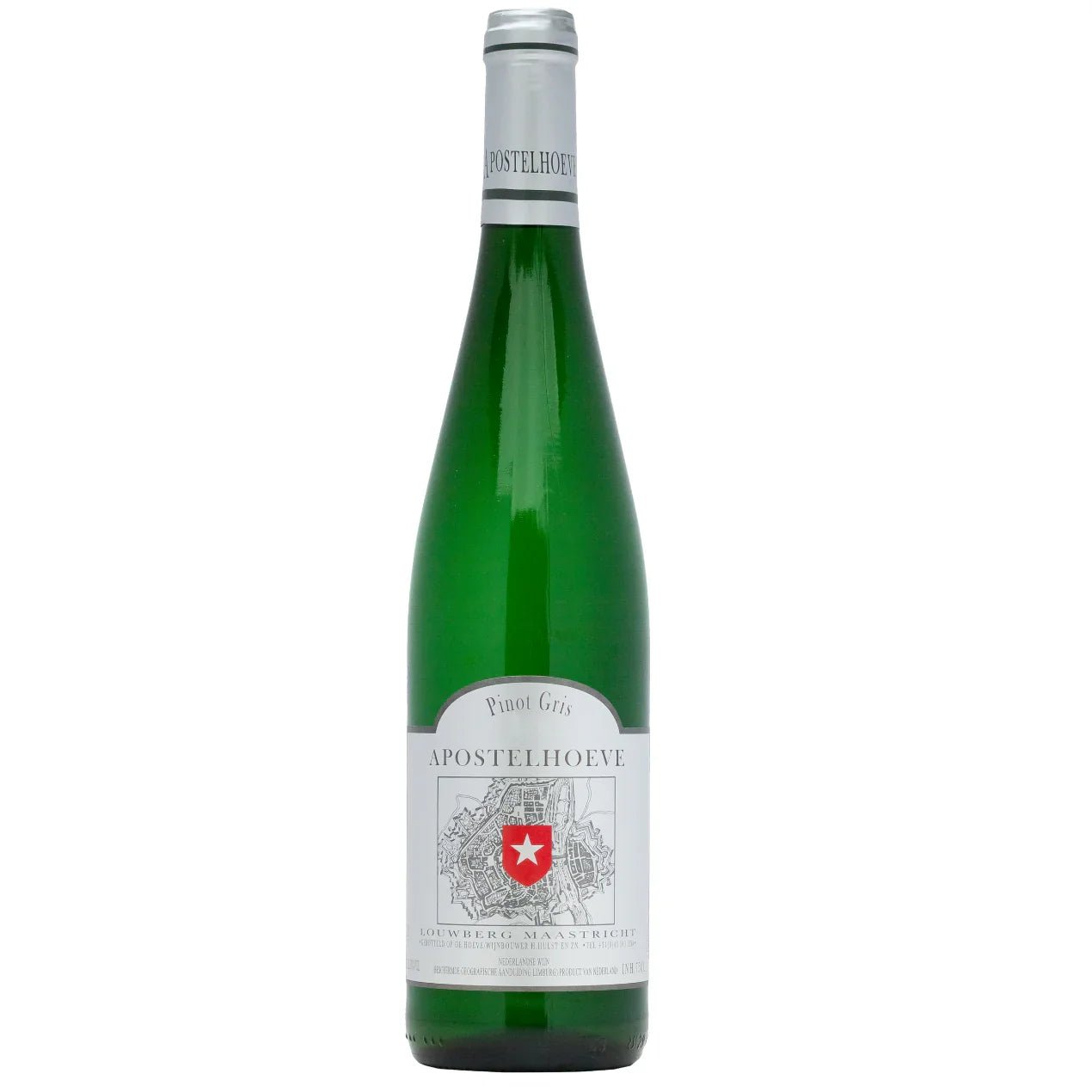
Aan de Poel
Aan de Poel - Wine with the Foie Gras
Classification: BOB Mergelland
Color: Full-bodied white wine
Country: Netherlands
Region: Maastricht
Producer: Familie Hugo Hulst and Son, Maastricht
Grape varieties: Pinot gris
Wine production: The grapes are picked by hand. In a state-of-the-art press, they are macerated, gently pneumatically pressed and clarified. Fermentation takes place at 13 to 17°C in stainless steel tanks. The wine is bottled in the spring.
Producer information: The Apostelhoeve is a beautiful, old farmstead located on the Louwberg near Maastricht. The vineyards are situated on the southern slopes of the Jekerdal on a humus-rich soil on sand and gravel with marl/limestone as the subsoil. In 1970, Hugo Hulst planted a vineyard as an experiment. In the first years, alcohol percentages of about 10 percent were achieved; nowadays, at the Apostelhoeve, a natural alcohol percentage of 12.5 or 13 percent is quite common. The results were encouraging and the vineyard was expanded. In the meantime, müller-thurgau, riesling, auxerrois, pinot gris and viognier have been planted. In addition to wine, fruit cultivation was still an important source of income for the Hulst family; now it is wine production. As of 2020, the vineyard covers more than 14 ha, with an average annual production of 110,000 bottles. In 2012, the cellar was expanded by 300 m2 and equipped with a computer-controlled press, in which the grapes, protected from oxygen, are macerated for 4 to 5 hours, gently pressed and the juice is clarified. Since 2014, the harvest for the still wines has been brought in by a harvesting machine, currently the only one in the Netherlands. Son Mathieu is the passionate winemaker, his wife Julka is of great value to the company, and with the entry of Mathieu’s sons Robin and Gilbert, the third generation, continuity is assured. After 50 years, the Apostelhoeve stands at the absolute top of Dutch wine estates. The wines are praised in both national and international press.
Area information: In the Middle Ages, thousands of hectares in the south of our country were planted with vines. After a period of decline, a turnaround began in 1970. Various pioneers planted vineyards with varying degrees of success. The vineyards of the Apostelhoeve have a fantastic location on steep slopes with a warm, humus-rich soil on sand and gravel with marl/limestone as a subsoil. The small river Jeker meanders through the valley and provides the right microclimate. At present, more than 200 hectares of vineyards have been planted in the Netherlands, both as a hobby and professionally. Limburg and Gelderland are the provinces with the largest yield and highest concentration of wine companies. Many wine companies have planted fungus-resistant grape varieties. This is because spraying with copper is prohibited in the Netherlands. In Limburg, the number of companies working with classic grape varieties is the highest. The South Limburg climate, in combination with the right soil and the favorable location of many plots, means that an increasing number of companies – also just across the border in Belgium – are making wines that hardly fall short of the better wines from classic wine countries such as France, Germany, and Italy. The conditions are – partly due to climate change – even so favorable that viticulture in these regions is becoming an economically significant factor. The BGA category (Protected Geographical Indication) is the Dutch name for the European IGP category (country wine). Since early 2018, the BOB appellation (Protected Designation of Origin) Mergelland may be used.
Serving suggestions: As an aperitif, with light fish dishes, shellfish, white meat and poultry such as rillettes, combinations with Asian flavors, pastas, vegetable dishes, salads.
Serving temperature: 10 to 12ºC
Additional information: In the short history of the 'Confrérie des Vins Limbourgeois', the Apostelhoeve was named 'Winery of the Year' in both Dutch and Belgian Limburg for the 7th time in 2011.
Couldn't load pickup availability
Shipping information
We deliver throughout the Netherlands (with the exception of the Wadden Islands). Our refrigerated delivery costs are €6.90 (excluding €3 service fees).
Please note: on Sunday, April 20, we will charge an increased delivery fee of €19.80 due to the national holiday. You can also choose to have your meal delivered on Saturday, April 19 for €6.90 and eat it on Sunday evening.
A small number of exclusive restaurants use a private "priority delivery service". This service costs €29.
The delivery fees we charge cover the refrigerated pickup from the restaurant and ensure that your meal is delivered to your home under optimal conditions. You will be continuously informed of the status of your order. In addition, we work with a specialized courier service that transports each meal with the greatest possible care and attention.
Tab
Tab
Classification: BOB Mergelland
Color: Full-bodied white wine
Country: Netherlands
Region: Maastricht
Producer: Familie Hugo Hulst and Son, Maastricht
Grape varieties: Pinot gris
Wine production: The grapes are picked by hand. In a state-of-the-art press, they are macerated, gently pneumatically pressed and clarified. Fermentation takes place at 13 to 17°C in stainless steel tanks. The wine is bottled in the spring.
Producer information: The Apostelhoeve is a beautiful, old farmstead located on the Louwberg near Maastricht. The vineyards are situated on the southern slopes of the Jekerdal on a humus-rich soil on sand and gravel with marl/limestone as the subsoil. In 1970, Hugo Hulst planted a vineyard as an experiment. In the first years, alcohol percentages of about 10 percent were achieved; nowadays, at the Apostelhoeve, a natural alcohol percentage of 12.5 or 13 percent is quite common. The results were encouraging and the vineyard was expanded. In the meantime, müller-thurgau, riesling, auxerrois, pinot gris and viognier have been planted. In addition to wine, fruit cultivation was still an important source of income for the Hulst family; now it is wine production. As of 2020, the vineyard covers more than 14 ha, with an average annual production of 110,000 bottles. In 2012, the cellar was expanded by 300 m2 and equipped with a computer-controlled press, in which the grapes, protected from oxygen, are macerated for 4 to 5 hours, gently pressed and the juice is clarified. Since 2014, the harvest for the still wines has been brought in by a harvesting machine, currently the only one in the Netherlands. Son Mathieu is the passionate winemaker, his wife Julka is of great value to the company, and with the entry of Mathieu’s sons Robin and Gilbert, the third generation, continuity is assured. After 50 years, the Apostelhoeve stands at the absolute top of Dutch wine estates. The wines are praised in both national and international press.
Area information: In the Middle Ages, thousands of hectares in the south of our country were planted with vines. After a period of decline, a turnaround began in 1970. Various pioneers planted vineyards with varying degrees of success. The vineyards of the Apostelhoeve have a fantastic location on steep slopes with a warm, humus-rich soil on sand and gravel with marl/limestone as a subsoil. The small river Jeker meanders through the valley and provides the right microclimate. At present, more than 200 hectares of vineyards have been planted in the Netherlands, both as a hobby and professionally. Limburg and Gelderland are the provinces with the largest yield and highest concentration of wine companies. Many wine companies have planted fungus-resistant grape varieties. This is because spraying with copper is prohibited in the Netherlands. In Limburg, the number of companies working with classic grape varieties is the highest. The South Limburg climate, in combination with the right soil and the favorable location of many plots, means that an increasing number of companies – also just across the border in Belgium – are making wines that hardly fall short of the better wines from classic wine countries such as France, Germany, and Italy. The conditions are – partly due to climate change – even so favorable that viticulture in these regions is becoming an economically significant factor. The BGA category (Protected Geographical Indication) is the Dutch name for the European IGP category (country wine). Since early 2018, the BOB appellation (Protected Designation of Origin) Mergelland may be used.
Serving suggestions: As an aperitif, with light fish dishes, shellfish, white meat and poultry such as rillettes, combinations with Asian flavors, pastas, vegetable dishes, salads.
Serving temperature: 10 to 12ºC
Additional information: In the short history of the 'Confrérie des Vins Limbourgeois', the Apostelhoeve was named 'Winery of the Year' in both Dutch and Belgian Limburg for the 7th time in 2011.
Shelf life
Shelf life
We advise consuming the dishes within 2 days of receipt.
Aan de Poel - Wine with the Foie Gras